- Posted On:2026-03-18 13:03
-
673 Views
From Campus Inquiry to Professional Practice: Minghui Li’s Data-Driven Path in Contemporary Urban Planning

In recent years, the urban planning profession has been undergoing a quiet but consequential shift. As cities face mounting pressures—from climate resilience and infrastructure aging to social equity and governance transparency—planners are increasingly expected to work not only with spatial form, but with data, systems, and decision-making frameworks. Against this backdrop, Minghui Li’s professional trajectory offers a clear example of how a new generation of planners is redefining the field through applied analysis, technical integration, and sustained engagement with real-world complexity.
Li, currently a Planning Systems Associate at MKThink in San Francisco, represents a profile that has become increasingly relevant in contemporary practice: a designer trained in spatial thinking, but operating at the intersection of planning analytics, visualization systems, and collaborative decision support. Her work reflects a gradual evolution—from academic exploration to professional execution—marked less by abrupt shifts than by a consistent deepening of methodological rigor and responsibility.
Photo · Ms. Minghui Li
Li’s education laid the conceptual groundwork for this trajectory. Trained in architecture and urban design at Tianjin University, UCLA, and later the University of Michigan, she was exposed early to questions of scale, public space, and social context. Yet colleagues and instructors have noted that her distinguishing characteristic during this period lay not only in stylistic expression, but also in a strong analytical curiosity. Her academic projects consistently emphasized systems mapping, scenario testing, and the translation of abstract urban issues—such as cultural heterogeneity or housing inequality—into spatial and visual frameworks that could be interrogated rather than merely represented.
That analytical orientation did not remain confined to the studio environment. During her time at the University of Michigan, Li participated in interdisciplinary initiatives addressing housing inequality in Detroit, contributing scenario design, visual simulations, and explanatory animations. These experiences, while academic in setting, introduced her to the constraints and ambiguities that define real urban problems—constraints that would later become central to her professional work. Importantly, these projects trained her to treat visualization not as an end product, but as a communicative bridge between data, policy questions, and public understanding.
Building directly on this experience, Li developed the Community Data–Based Public Space Planning Support Platform V1.0 in 2023, an original planning assistance system that consolidates community-level data to inform public space decision-making. While the platform itself is not the centerpiece of her career narrative, it encapsulates a broader professional philosophy: that public space planning should be guided by evidence, transparency, and adaptability. The project was later recognized with the 2024 Future Pioneer Award for Data-Driven Urban Design Innovation, reflecting its relevance within contemporary professional practice.
The transition from campus to professional practice marked a decisive expansion of scope. After early professional exposure through internships in China and design firms in the United States, Li joined MKThink in late 2024 as a Planning Systems Associate. The role placed her directly within multidisciplinary planning teams working on large-scale, publicly visible projects, including the Earl Warren Showgrounds Master Plan in Santa Barbara, the Central Maui Planning and Design Guidelines, and the Pacific School of Religion campus vision and space evaluation.
In these contexts, Li’s responsibilities extended well beyond conventional design support. She developed concept drawings and 3D visualizations, conducted site and spatial analysis, constructed Logom diagrams to clarify organizational logic, and produced Revit-based models and axonometric views to test planning strategies. More significantly, she contributed GIS-based community needs analysis, helping teams align spatial proposals with demographic patterns, accessibility considerations, and programmatic equity goals. Her work was frequently used not only for internal decision-making, but also for communication with clients, stakeholders, and the public through structured InDesign reports and presentation materials.
What distinguishes Li’s professional contribution is her approach to planning as a systems-based problem rather than a purely spatial one. Colleagues have observed that she frequently emphasizes how urban plans fail not due to weak design intent, but because of insufficient feedback mechanisms between data, decision-makers, and implementation. This perspective is reflected in her involvement with planning systems that integrate spatial analysis, visualization, and iterative review—tools specifically designed to narrow the gap between analytical insight and real-world action.
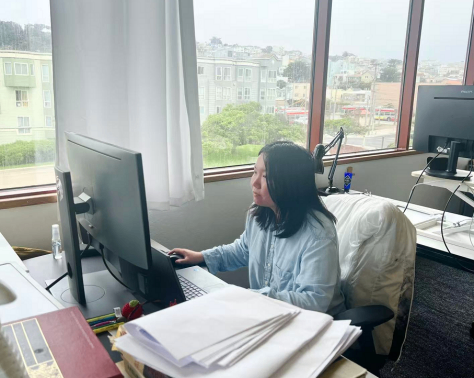
Photo · Ms. Minghui Li at Work
Li’s work demonstrates a consistent ability to operate across scales—from regional frameworks to site-specific strategies—while maintaining clarity of logic and intent. She is equally adept at producing technical GIS analyses, spatial diagrams, and visual narratives, treating each not as isolated deliverables but as components of an integrated decision-making ecosystem. Industry observers note that this approach reflects a broader shift within the planning profession. As cities increasingly demand transparency and accountability, planners are expected to justify decisions through data, scenario testing, and clear communication. Li’s work aligns closely with this evolution, framing planning not as a static blueprint but as an ongoing process of evaluation supported by adaptable, data-driven tools responsive to social, environmental, and institutional change.
Looking ahead, Li has indicated an interest in further integrating intelligent systems into spatial decision-making, particularly in areas where planning intersects with public participation and long-term governance. Her trajectory suggests a practitioner less concerned with stylistic authorship than with structural impact—someone focused on how planning systems function over time, across stakeholders, and under real constraints.
In an era when urban planning is being asked to reconcile complexity with clarity, Minghui Li’s growth from academic inquiry to professional responsibility offers a measured, evidence-based model of practice. Her work illustrates how careful analysis, technical fluency, and a commitment to public relevance can converge into a form of professional distinction—one defined not by spectacle, but by sustained, thoughtful contribution to the cities of tomorrow.